A key feature of the life-cycle of trematodes of veterinary and medical importance is the use of snails as the first intermediate host. Typically, one learns the names of the various snails and goes on one's merry way. I thought it would be an intellectually engaging exercise to learn a little bit more about these intermediate hosts par excellence.
 |
Galba truncatula
By Peter Glöer & Vladimir Pešić
[CC BY 3.0 (https://creativecommons.
org/licenses/by/3.0)],
via Wikimedia Commons |
 |
Pseudosuccinea columella
By Francisco Welter Schultes ,
Public Domain,
https://commons.wikimedia
.org/w/index.php?curid=14726645 |
The intermediate hosts for the famous ruminant trematodes
Fasciola and various Paramphistomes is an air breathing freshwater pond snail belonging to the genera
Galba (previously
Lymnaea) in the Family Lymnaeidae.
Galba truncatula, commonly known as the dwarf pond snail
, is found in North and South America, Africa and Asia, and are notably absent in Australia. In the United States and Australia,
Fasciola is transmitted by another snail called
Pseudosuccinea columella. Another snail called
Fossaria bulimoides can also host
Fasciola. The vectorial capacity of Pseudosuccinea columella is marked because it can also be the first intermediate host of
Heterobilharzia americana, the etiological agent of canine schistosomiasis in North America.
Like so many other organisms, the taxonomy of members of the family Lymnaeidae is under dispute, since Lymaeid snails are known to exhibit diversity and plasticity in shell appearance. Only 8 species inhabiting the Neotropics are considered as intermediate hosts of
Fasciola hepatica, as described in a 2011 paper published in the journal Infection, Genetics and Evolution by Correa et al
. These are
Galba cousini,
G. cubensis,
G. neotropica,
G. truncatula,
G. viatrix,
Lymnaea diaphana,
L. rupestris and
Pseudosuccinea columella. It is also interesting to note that
Lymnaea fuscus (Stagnicola fuscus) is partially resistant to infection with
Fasciola hepatica while
Stagnicola elodes is completely refractory.
 |
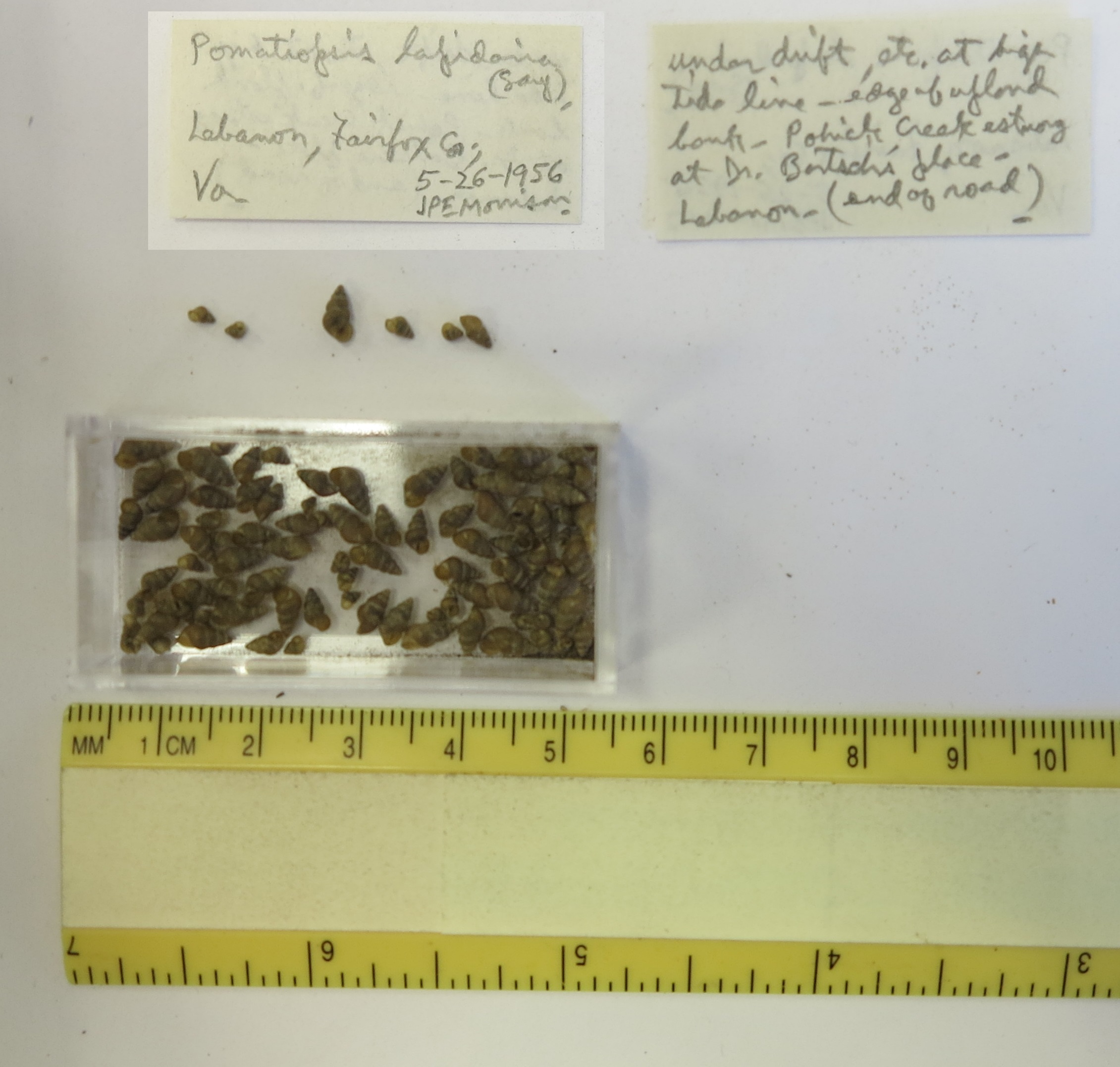
Stagnicola fuscus which is partially
resistant to infection by F. hepatica.
Image attribution : Francisco Welter Schultes /
Public domain via wikimedia.
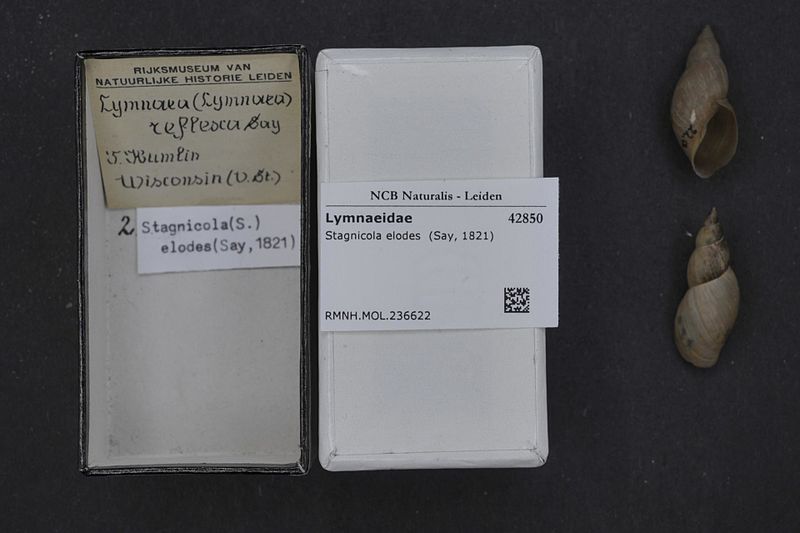 |
Stagnicola elodes which is completely
refractory to infection with F. hepatica.
Image attribution: Naturalis Biodiversity Center / CC0 via wikimedia
|
|
In general,
Galba spp. can be identified by their turriform yellow to brownish shell of less than 7 - 10 mm height, an oval aperture less than 0.5 times the height of the shell, short spire, 5-6 inflated stepped whorls (the spiral structures of mollusc shells) and straight columellar edge. There may be striations on the shell.
Pseudosuccinea columella, also known as the American ribbed fluke snail, has a thin translucent shell that is brown with fine striations. It has 3.5-4 weakly convex whorls that end in a point. The aperture is oval with a straight columellar margin that is reflected only in the upper part. These snails may have white spots and measure 1.5 - 2 cm.
However, given that morphological identification beyond genus level may be hard, the use of molecular techniques is recommended. In the same paper, Correa et al. characterized the 18S, ITS-1, ITS-2 and CoxI genes of the 8 Neotropical species for ease of identification in cases where morphological characteristics are confusing/inadequate to identify a given lymnaeid specimen to species level.
So the next time you see a snail in stagnant waters/ water-associated environs such as reeds/mud, you can try to see if it is
Galba or
Pseudosuccinea.
References:
Title reference: The title of this post is a play on the common name of the snail (Dwarf pond snail) and a reference from the Lord of the Rings. Galadriel says " Let none say again that Dwarves are grasping and ungracious" to the parting fellowship (Ref here).
Correa AC, Escobar JS, Noya O, Velásquez LE, González-Ramírez C, Hurtrez-Boussès S, Pointier JP. Morphological and molecular characterization of Neotropic Lymnaeidae (Gastropoda: Lymnaeoidea), vectors of fasciolosis. Infect Genet Evol. 2011 Dec;11(8):1978-88.
Animal base: http://www.animalbase.uni-goettingen.de/zooweb/servlet/AnimalBase/search